One Shift, Two Systems: What Ripplemesh Sees That a Typical HR Suite Doesn't

Ripplemesh is a learning platform that also records the work, the risk and the outcomes around it. It measures learning against ISO/TS 30437, the international standard for learning and development metrics. This page compares what it records with what a leading HR suite, SAP SuccessFactors, typically records.
The story
Maria is a maintenance technician at an industrial plant. Here is her Thursday.
6:00 AM, arrival
Ripplemesh holds the working picture of this employee and her role. That includes her qualifications and expiry dates, her skill profile and her shift log. Ripplemesh adds skills evidenced by the work itself, such as permits, work orders and incidents.
7:00 AM, shift handover
She reads the previous crew's notes. Ripplemesh keeps shift logs and handover summaries, and each one becomes a learning and operations signal.
8:30 AM, a work order
A pump needs repair. She opens a work order, checks parts inventory and photographs the failed seal. Ripplemesh records the work order, parts used, photos, meter readings, inspection rounds, calibration and equipment status. These sit outside the HR boundary, so HR suites do not typically hold them.
9:15 AM, permits
Before she opens the line she needs lockout/tagout, a permit to work and a confined-space permit. Ripplemesh records each permit and checks that she holds the qualifications it requires.
11:00 AM, a near miss
A valve weeps, and she files an incident report with location and photos. Ripplemesh follows it through investigation, root cause analysis, corrective actions, regulatory reporting and handoffs to training and operations. It then links the incident to the course that should have prevented it and flags that course for review. An HR suite can record that she completed a safety course. Connecting the incident to a training gap is outside its usual scope.
1:00 PM, team meeting
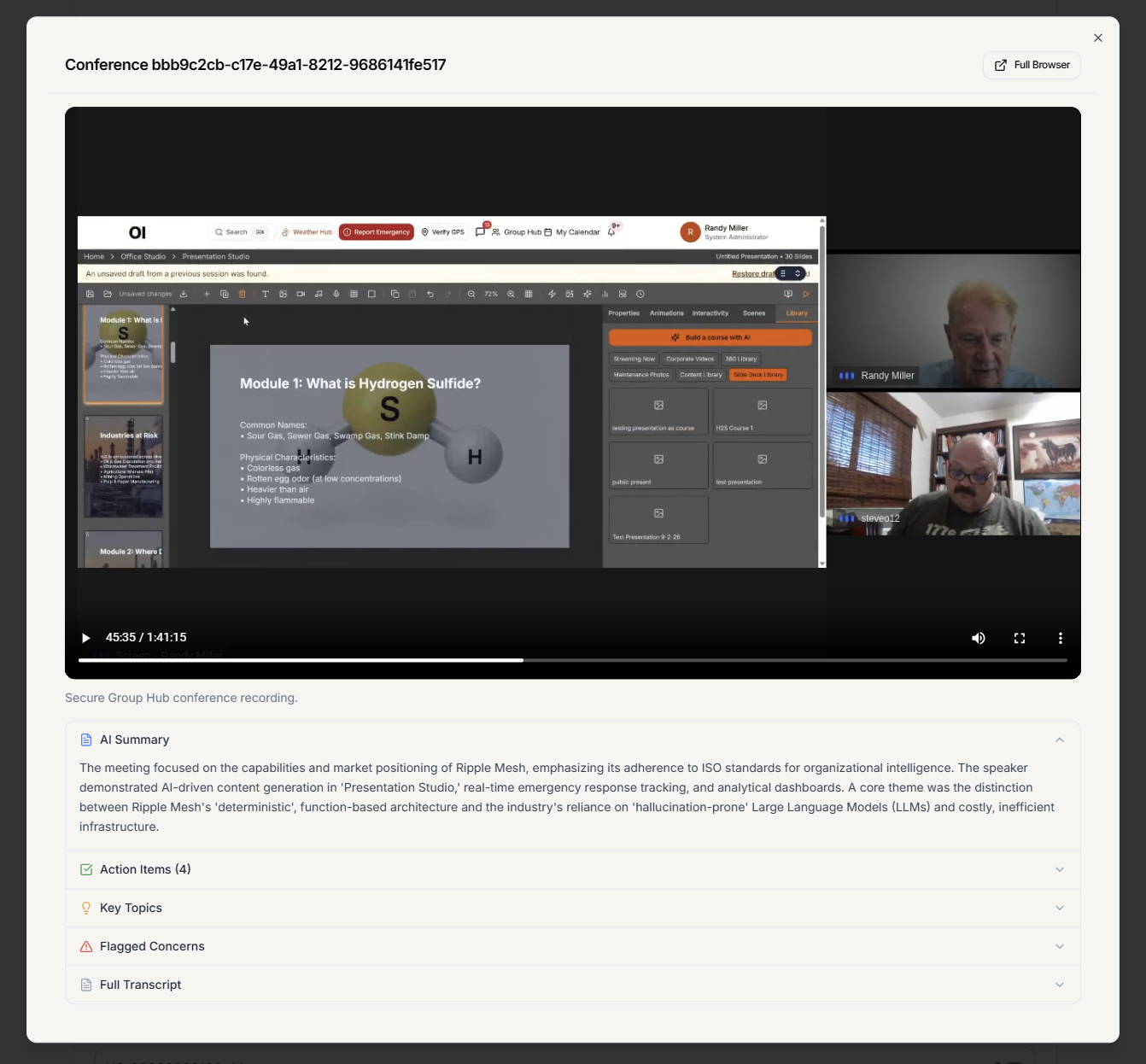
Her team meets on Ripplemesh Group Hub video. Ripplemesh stores the recording, transcript, AI summary, action items and flagged concerns.
2:30 PM, learning
She takes a course and an assessment. SuccessFactors Learning handles this well, with enrollments, completions, scores, transcripts and certificates. Ripplemesh records those too, and then measures the whole learning programme against ISO/TS 30437: • Level 1, reaction: participant reaction and objective owner satisfaction. • Level 2, learning: knowledge test scores, first-attempt pass rates and attempts to pass. • Level 3, application: intent to apply and actual application on the job. • Level 4, impact: the isolated impact of learning on injuries, productivity, sales and engagement. • Level 5, return on investment: net benefit against total programme cost, including the value of the learner's time. It also records every view, click and decision in a presentation, simulation performance with spatial heatmaps, and video engagement.
3:30 PM, mentoring and informal learning
She logs time with a mentor. Ripplemesh also tracks informal learning the way the standard asks: communities of practice and their active members, performance support tools and their users, documents accessed in the learning portal, and satisfaction with each.
4:00 PM, field observation
She completes a behavior observation. Ripplemesh records observation surveys, field observations and safety audits.
5:00 PM, capturing expertise
A retiring expert is interviewed by voice about procedures that were never written down. Ripplemesh turns the interview into a reviewed knowledge profile. It holds source-quoted claims, a knowledge graph, SOP drafts, failure scenarios and a training plan.
After hours, leadership
Plant leadership sees one picture: programs, projects, risks, budgets, KPIs, labor relations, resources and documents. The learning scorecards follow the standard's five audiences: senior leader, group leader, head of learning, programme manager and learner. Each links back to the people involved.
The difference
An HR suite describes the employee and their HR lifecycle. Ripplemesh describes the work, the risk and the learning, measures the learning to an international standard, and links it all back to the employee. The two work well together.
ISO/TS 30437 learning metrics, in detail
ISO/TS 30437:2023 groups its recommended metrics into three types: outcome, effectiveness and efficiency. It covers formal and informal learning and includes all eight learning metrics from ISO 30414. The table lists each group and what Ripplemesh reports. The SuccessFactors column reflects standard learning reports and, where SAP has no published equivalent, says so.
| ISO/TS 30437 metric group | Ripplemesh metrics | SAP SuccessFactors Learning (typical) |
|---|---|---|
| Outcome: impact of learning (level 4) | Isolated impact on injuries, productivity, sales, engagement, with percentage contribution from learning | Typically needs custom analytics |
| Outcome: results (level 4) | Change in the organizational metric the course targets | Typically needs custom analytics |
| Outcome: workforce competency rate, competency rating | Weighted average competency by team, group and organization, with before and after training ratings | Competency libraries and ratings. Weighted workforce rate typically via reporting |
| Outcome: job performance, objective owner expectations met | Job performance improvement and whether the sponsor's expectations were met | Typically outside scope |
| Effectiveness: participant reaction (level 1) | Percent favourable and average score by course | Course evaluations |
| Effectiveness: objective owner satisfaction (level 1) | Sponsor satisfaction with the course and the learning department | Typically outside scope |
| Effectiveness: learning (level 2) | Knowledge test score, first-attempt pass rate, attempts to pass | Assessment scores |
| Effectiveness: application of learning (level 3) | Intent to apply and actual application, from follow-up surveys | Typically outside scope |
| Effectiveness: return on investment (level 5) | Net benefit over total programme cost, including opportunity cost of learner time | Typically needs custom analytics |
| Effectiveness, informal: user satisfaction | Satisfaction with the learning portal, communities of practice and performance support tools | Typically outside scope |
| Efficiency, all learning: unique participants, total participants | Both counts, segmented by group, with cohort and individual views | Participation reports |
| Efficiency, all learning: reach, percentage of employees reached by learning | Formal and tracked informal learning combined | Typically formal learning only |
| Efficiency, all learning: employees with individual development plans, existence of a plan | Plan coverage and per-learner plan status | Development plans in talent modules |
| Efficiency, all learning: total cost, budget, cost reduction | Total cost by programme and organization, budget, cost per learner | Cost reporting varies by setup |
| Efficiency, formal: average formal training hours, percentage participating in formal learning, by category | Hours and participation, segmented by category | Standard learning reports |
| Efficiency, formal: compliance and ethics completion | Percentage of assigned employees who completed required training | Compliance training reports |
| Efficiency, formal: leaders who participated in training and in leadership development | Both percentages for leaders | Possible with custom reports |
| Efficiency, formal: completion rate, completions, completion date, target audience | Completion against target audience or registrations, with planned and actual dates | Completion reports |
| Efficiency, formal: courses available and used, percentage by type of learning | Utilization of the catalogue by instructor-led, virtual, e-learning, mobile and blended | Catalogue and activity reports |
| Efficiency, formal: unique and total hours available and used | Hours offered and consumed, used to flag low-use courses | Hours reporting |
| Efficiency, formal: courses developed and delivered on time | On-time percentages against schedule | Typically outside scope |
| Efficiency, formal: unique employees and FTE in L&D, utilization rate | Learning department staffing, instructor and classroom utilization | Typically outside scope |
| Efficiency, informal: documents available and accessed, percentage using the portal | Portal utilization, unique users of content, total documents accessed | Typically outside scope |
| Efficiency, informal: communities of practice | Active communities and active members | Typically outside scope |
| Efficiency, informal: performance support tools | Tools available, tools used, unique users | Typically outside scope |
| Reporting | The standard's four report types: scorecards, dashboards, programme evaluation reports and management reports | Standard reports and dashboards |
| Audiences | Scorecards for senior leader, group leader, head of learning, programme manager and learner | Role-based reports |
Side-by-side data comparison
SuccessFactors information reflects SAP documentation and general product knowledge. Modules, licensing, release and configuration vary by customer, so "typically outside scope" means a standard SuccessFactors deployment does not usually include it. Other SAP products may cover some of these areas.
| Area | Ripplemesh | SAP SuccessFactors (typical) |
|---|---|---|
| Core employee record | Managed user, role, position, org chart, job descriptions | Employee Central: job, org, pay, location, history. Deeper |
| Hiring and onboarding | Job postings, applications, resume parsing, onboarding checklists | Recruiting and Onboarding. Deeper |
| Compensation and payroll | Not offered | Compensation and payroll integration |
| Time off and attendance | Time-off requests, time entries, shift logs | Time off and time tracking |
| Performance and goals | Reviews, goals, high-potential flags | Performance and Goals, 360 reviews, calibration |
| Succession and talent | Succession plans, turnover risk, career paths | Succession and Development, talent pools. Comparable |
| Course records | Courses, versions, sessions, enrollments, assessments, certificates | Catalog, enrollments, completions, scores, certificates. Comparable |
| Learning measurement | The full ISO/TS 30437 set: outcome, effectiveness and efficiency metrics for formal and informal learning (see the detailed table) | Standard learning reports. Outcome and ROI typically need custom analytics |
| Credentials | Credentials, competency programs, external credentials, linked to KPIs and courses | Certifications and curricula |
| Skills and competencies | Frameworks, skill ontology, endorsements, gaps, and skills inferred from learning and operational activity such as permits, work orders and incidents | Talent Intelligence Hub with a skills ontology. AI skills inference from performance inputs such as achievements, activities and feedback |
| Learning behavior | Statement-level activity: views, clicks, answers, video, simulations, mentoring, informal learning | Typically completion, score and time |
| Training effectiveness | Reaction, behavior and application surveys, isolated impact, ROI, effect on injuries and productivity | Typically needs custom analytics |
| Informal learning | Communities of practice, performance support tools, portal documents, mentoring, each with usage and satisfaction | Limited |
| Simulation and XR | Scores, step-by-step actions, spatial heatmaps | Typically outside scope |
| Safety incidents | Full lifecycle, root cause analysis, corrective actions, regulatory reporting | Typically outside scope (SAP offers EHS in other products) |
| Safety permits | Lockout/tagout, permit to work, confined space, H2S, bypass | Typically outside scope |
| Maintenance and assets | Work orders, parts, inspections, calibration, meter readings, equipment status | Typically outside scope (SAP offers asset management in other products) |
| Sensors and robotics | Sensor readings, robot fleet status | Typically outside scope |
| Emergency and location | Emergency events, location beacons, weather | Typically outside scope |
| Meetings | Recordings, transcripts, AI summaries, action items | Typically outside scope |
| Collaboration | Group sites, channels, announcements, forums | Limited |
| Projects and programs | Tasks, milestones, risks, budgets, earned value, lessons learned | Typically outside scope |
| Strategy and KPIs | KPIs, organizational metrics, SWOT, stakeholders, communications plans | Limited |
| Labor relations | Grievances, bargaining agreements, union surveys and meetings | Typically outside scope |
| Knowledge capture | Voice interviews, source-quoted claims, knowledge graph, SOP drafts | Typically outside scope |
| Experience and semantic layer | Permanent experience ledger, concept graph, pattern discovery, "who holds this role" queries | Typically outside scope |
| Documents | Document hub, workflow, versions, accessibility scans, access logs | Limited |
| Privacy and compliance | Processing records, consent audits, PII access audits, offboarding audits | Standard HR privacy tools |
| AI usage and agents | AI cost tracking, agent findings, audit logs | Typically outside scope |
| Surveys | Surveys, reaction, behavior and union surveys | Engagement surveys, available through Qualtrics XM for Employee Experience under an SAP Endorsed Apps agreement |
| Support | Support tickets, maintenance tickets, feedback | Typically outside scope |
xAPI and content standards
Based on SAP's published feature scope and roadmap statements. Confirm against the current SAP Help Portal "What's New" for your Learning release.
| Dimension | Ripplemesh | SAP SuccessFactors Learning |
|---|---|---|
| Content standards | Experience statements are the native data model. No content package is needed to record activity. | SCORM 1.2, SCORM 2004 and AICC are the supported core. cmi5/xAPI with a built-in learning record store has been on SAP's roadmap. Verify against your release. |
| General xAPI content | Any module, simulation, tool or automation can write a statement. | Arbitrary xAPI content should not be assumed to work. cmi5 is a launch profile, not open xAPI. |
| Where statements go | A permanent, directly queryable ledger with no separate store. | In a standard deployment, into the learning record: completion, pass/fail, score, time. Full xAPI analytics has typically meant adding a separate learning record store. A built-in one is a roadmap item. |
| Activity outside courses | Mentoring, informal learning, meetings, work orders, incidents, permits and shift logs are all captured. | In a standard deployment, not captured unless course content reports it. A roadmap LRS could change this. |
| Passive capture | Automations record statements when records change, with no user action. | Content must be instrumented. |
| Vocabulary | Governed verb registry with organization-specific verbs. | Standard completion model. |
| Privacy of the record | Statements use a non-personal actor ID, and personal data is stored separately. | Identity is part of the learning record. |
| Cross-hub analysis | Training is correlated with injuries, productivity, maintenance and ROI. | Learning reports. Outcome correlation needs custom analytics. |
What this means
SuccessFactors is a proven, enterprise-scale system of record for pay, recruiting, benefits, talent and formal HR processes, and it continues to add AI skills capabilities. Ripplemesh does not aim to replace it there.
Ripplemesh adds what happens on the job: whether the work is safe, whether the training worked, and who actually knows what. Its learning measurement follows ISO/TS 30437, from participant reaction through isolated impact and return on investment. It also reaches informal learning and operational records, not just HR data.