Ripplemesh OI Powers EnergyData.Stream, a Public Energy Intelligence Site
Data curation support for two signature hubs: Global Oil Refineries and the EIA Data Hub
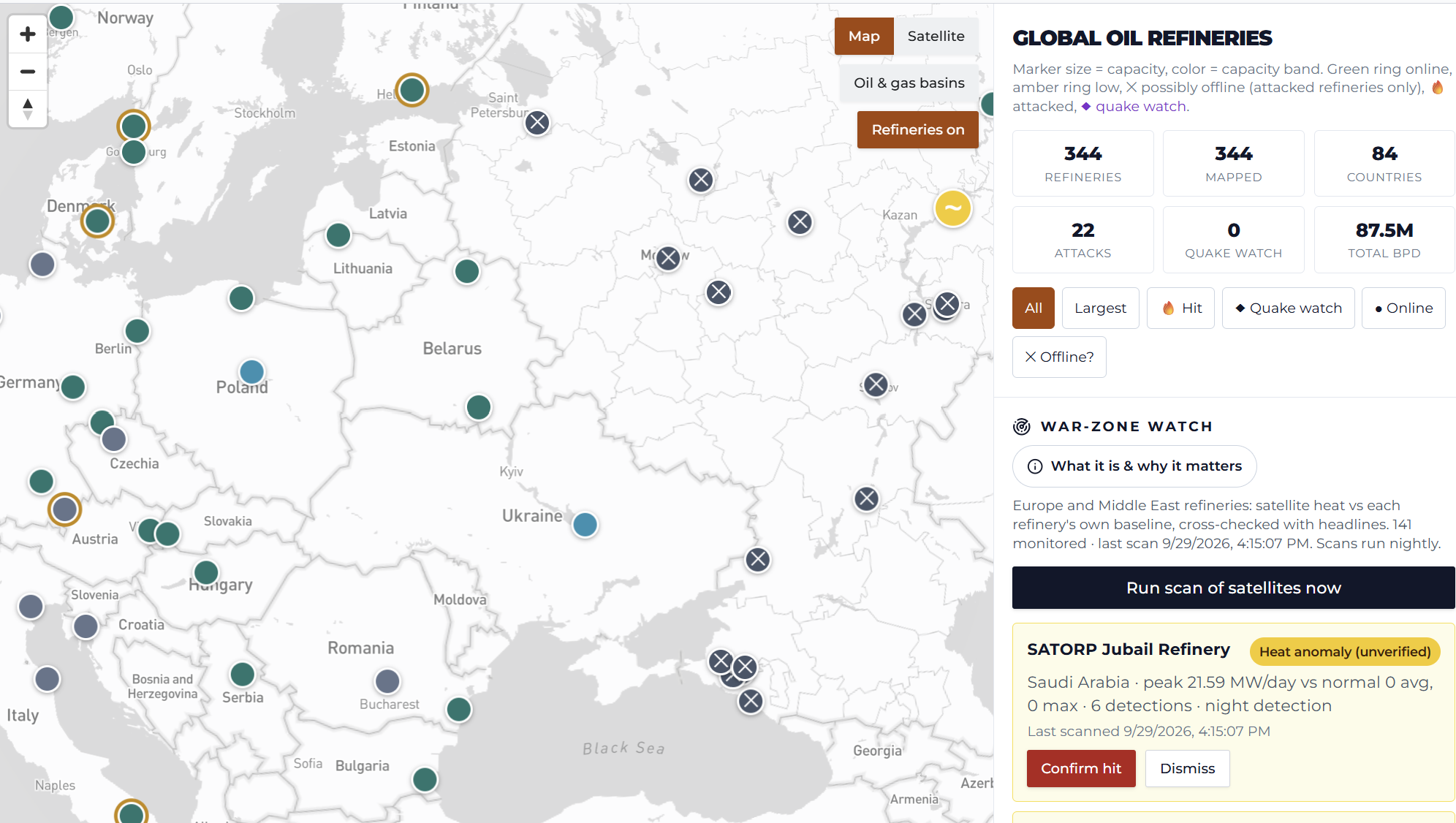
Ripplemesh Organizational Intelligence (Ripplemesh OI) today announced that its backend platform now provides data curation support for EnergyData.Stream, a public-facing energy intelligence site built on the Ripplemesh OI platform. The site launches with two signature hubs: the Global Oil Refineries hub, which tracks the current state of the world's major refineries using NASA satellite fire data, and the EIA Data Hub, which surfaces official U.S. Energy Information Administration statistics in a live, explorable format.
Global Refineries: tracking plant status from orbit
The Global Oil Refineries hub maps hundreds of the world's most significant refinery locations, with marker sizes and colors reflecting rated processing capacity. What sets the hub apart is how it answers a question that has been difficult to answer during recent periods of global conflict: which refineries are actually still running?
To answer it, EnergyData.Stream combines NASA's FIRMS (Fire Information for Resource Management System) satellite data with a Ripplemesh OI analysis engine. A nightly automated scan queries FIRMS detections for each monitored refinery and measures thermal activity — heat from flares and furnaces — within a three-kilometer radius of each site. The Ripplemesh algorithm then compares the most recent two days of detections against each refinery's own 22-day thermal baseline, establishing what normal operation looks like for that specific plant before classifying it.
Each refinery is classified into one of several watch states: monitoring (normal flare activity at baseline), heat_anomaly (a satellite heat spike above baseline, unverified), possible_hit (a heat spike paired with relevant news reporting within a short correlation window), confirmed (analyst-verified damage), or cleared (the spike has faded or was dismissed). In parallel, the engine computes an operating-state proxy — online, low, or none — based on how many of the last 22 days showed satellite heat at the site.
The system is deliberately careful with its evidence. NASA's satellite product tends to suppress steady, low-level industrial heat such as routine flaring, so an absence of detected heat is not by itself proof that a refinery is offline. The platform's "possibly offline" flag is therefore treated as meaningful primarily for refineries that have been publicly reported as struck in a kinetic attack, and every anomaly is cross-referenced against news headlines before it is surfaced as a possible hit. Analysts can confirm or dismiss any finding, keeping the map clear about what is verified versus what is only a signal.
The hub also layers on a global earthquake watch (flagging M4.5+ seismic events within roughly ten miles of refinery pins, with stronger filtering for M6.0+ events), U.S. shale play boundaries from the EIA, and global oil and gas basin overlays generously provided by the FracTracker Alliance (Ted Auch, Sarah Ponte Cabral). A Refinery Watch panel gives administrators a live feed of scan results with confidence levels and supporting headlines for every alert.
EIA Data Hub: official energy statistics, made explorable
The second hub brings the U.S. Energy Information Administration's public data directly into the platform. The EIA Data Hub covers spot prices for petroleum, natural gas, coal, and electricity, alongside curated datasets spanning petroleum and oil trends, natural gas, coal, electricity, nuclear outages, renewables, and emissions.
Data refreshes automatically on a daily schedule through the Ripplemesh OI backend, and each dataset preserves its full route detail so users can drill from a summary card down into individual series. An accompanying route-coverage view shows which EIA series are being tracked and how current each snapshot is, so users always know the freshness of what they're looking at.
One backend, public reach
EnergyData.Stream runs on the same Ripplemesh OI platform that powers organizational intelligence, training, and operations inside enterprises — meaning the same data pipelines, scanning algorithms, and admin controls that serve internal analysts now also serve a public audience. Public visitors can browse both hubs freely, while scan triggering and anomaly review are restricted to verified administrators through the platform's row-level security.
"Energy markets move on rumors, but plant status can be measured," said a Ripplemesh spokesperson. "By pairing NASA's satellite fire detections with our own baseline-based analysis, EnergyData.Stream gives the public a grounded, evidence-limited view of which refining capacity is running — and pairs it with official EIA statistics for everything else."
Both hubs are live now at energydata.stream.
About Ripplemesh OI
Ripplemesh Organizational Intelligence is a unified platform for organizational operations, training, safety, and analytics. Its backend supports dozens of production apps spanning learning management, incident investigation, maintenance, and intelligence workflows.
References
- EnergyData.Stream (opens in a new tab)
- NASA FIRMS — Fire Information for Resource Management System (opens in a new tab)
- U.S. Energy Information Administration (opens in a new tab)
- FracTracker Alliance (opens in a new tab)