508 Compliance by Design
Why 96% of Enterprise Software Fails Accessibility Law — and How Ripplemesh Is Built to a Standard the Industry Ignores
Randy Stewart Miller · Founder & CEO, Ripplemesh Corporation · 2026
"Accessibility compliance is not a checkbox. It is a constitutional obligation, a federal procurement requirement, and a civil rights standard. Ripplemesh is the only organizational intelligence platform built to 100% Section 508 and WCAG 2.1 AA compliance from the first line of code."
— Randy Stewart Miller, Founder & CEO, Ripplemesh Corporation
The Law Most Vendors Pretend Doesn't Apply to Them
Section 508 of the Rehabilitation Act of 1973, as amended by the Workforce Investment Act of 1998, is not optional. It is federal law. Every federal agency — and every contractor or vendor that sells digital products to a federal agency — is legally required to ensure that their information and communication technology (ICT) is accessible to people with disabilities, to the same standard available to those without disabilities.
The 2017 Refresh updated Section 508 to align with WCAG 2.0 Level AA — and as of 2026, the standard is actively moving toward WCAG 2.1 AA, closing gaps in mobile accessibility, cognitive accessibility, and touch interaction requirements.
The Legal Mandate
Section 508, 29 U.S.C. § 794d — every federal agency and every vendor delivering ICT to a federal agency must comply.
Who Must Comply
ALL federal agencies — DoD, VA, HHS, DHS, DOE, DOL, USDA — plus every contractor delivering ICT to them.
ADA Title II Rule (March 2024)
State and local governments must also comply — public schools, municipalities, county agencies, fire departments, public hospitals, utilities — all newly covered.
DOJ Title III
Extends to all "places of public accommodation," including digital platforms — covering commercial and public-facing SaaS applications.
⚠️ Penalties for Non-Compliance
- First violation: up to $55,000
- Each subsequent violation: up to $110,000
- Contract termination: federal contractors delivering non-compliant systems face contract termination and legal action
- Litigation surge: 3,948 ADA web accessibility lawsuits filed in 2025 — a 23.84% increase over 2024 (EcomBack 2025 Report)
- 4,187 ADA digital accessibility lawsuits filed through end of 2024; 48% of sued organizations were repeat defendants
The Scale of the Problem — 96% Are Failing
Despite decades of law, despite thousands of lawsuits, despite explicit federal procurement requirements — the web accessibility crisis has not improved. It has worsened.
297
average accessibility issues per webpage
AudioEye Digital Accessibility Index · 15,000 sites scanned · audioeye.comMost LMS, ERP, and operations platforms claim "accessibility support" in their marketing. In reality, automated scans consistently reveal hundreds of violations — low-contrast text, missing ARIA landmarks, unlabeled form elements, keyboard traps, no screen reader support. The gap between marketing claims and actual compliance is vast.
Why Most Platforms Fail — The Root Causes
Retrofitted, not designed in
Accessibility is added at the end of development, not engineered as a constraint from day one. The cost of remediation is 10–100× higher than building it in.
No automated testing in the CI/CD pipeline
Without continuous automated scanning, violations accumulate silently across every sprint and release.
Third-party component libraries
Unreviewed UI libraries introduce violations that the development team never sees — and the vendor never tests.
No ongoing audit cycle
A product passes one audit and is never re-tested. New features break what was compliant.
Speed-to-market incentives
Accessibility investment is routinely deprioritized when release timelines conflict with compliance requirements.
Why Government and Public Service Users Are Most at Risk
Ripplemesh's target users — government agencies, public utilities, first responders, municipalities, school districts, unions, defense contractors — face the highest legal and moral exposure from non-compliant vendor software.
Federal Agencies
Procuring non-compliant ICT violates Section 508 themselves — they inherit the liability of their vendors.
Veterans Affairs (VA)
Serves millions of veterans, many with service-connected disabilities — non-compliant software fails the people it is supposed to serve.
First Responders & Emergency Management
Legally required to be accessible — a firefighter or paramedic with a disability must be able to use the same digital tools.
Municipal Governments & Public Utilities
Newly under ADA Title II (2024 rule) — face lawsuit exposure for every inaccessible digital system they deploy or procure.
School Districts
Using non-compliant LMS platforms violates both Section 508 and IDEA (Individuals with Disabilities Education Act).
Union Organizations
Representing workers with disabilities — a specific ethical and legal obligation to use accessible digital tools for member communications.
The Procurement Trap — VPATs
When a government agency selects a vendor, it typically requires a VPAT (Voluntary Product Accessibility Template) — a self-reported document the vendor fills out claiming compliance. Most VPATs are not independently verified. They are marketing documents. The agency trusts the claim. The product ships. The employees and public members with disabilities pay the price.
Ripplemesh — Built to the Standard, Not Retrofitted to It
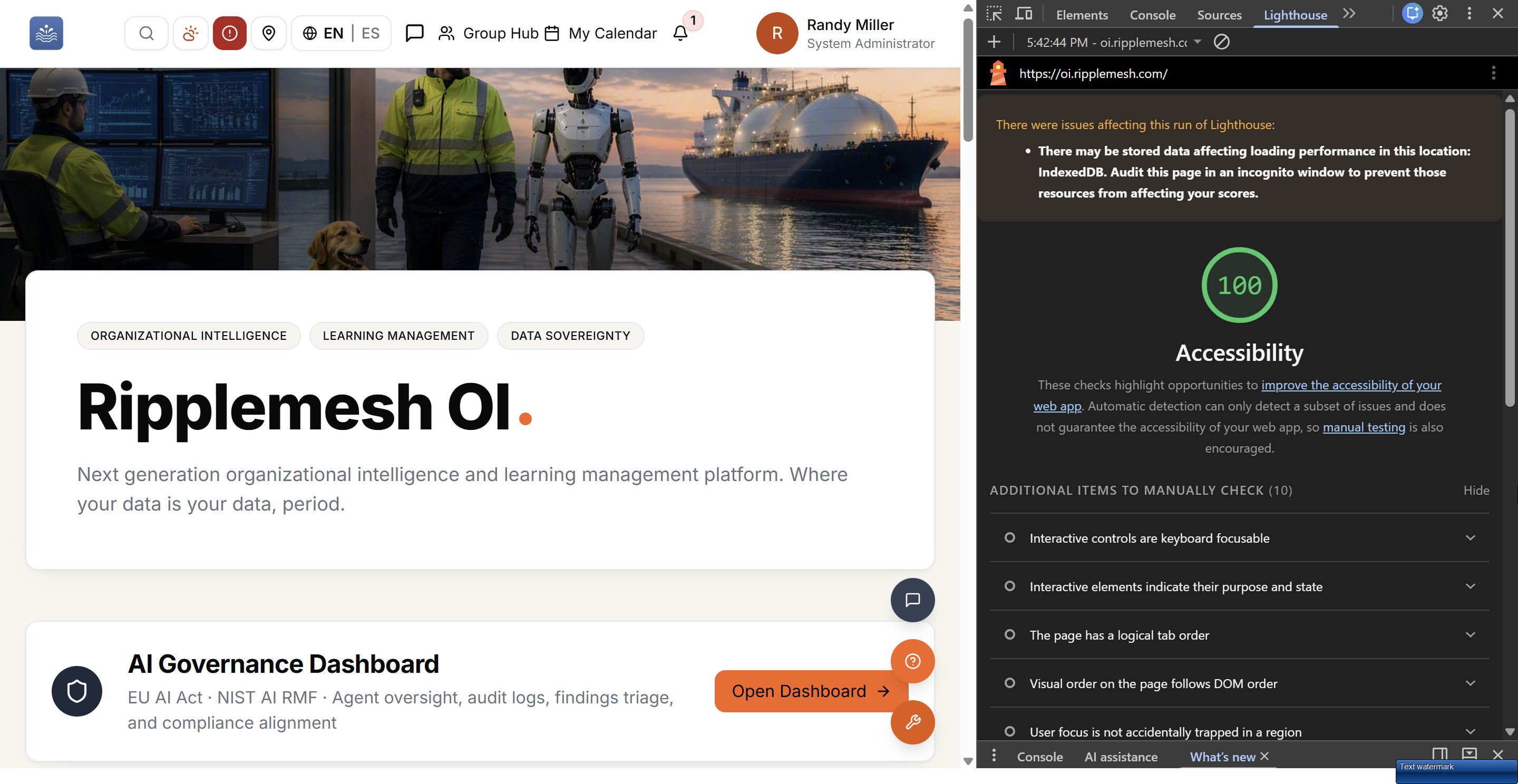
Google Lighthouse Accessibility Score
100 / 100
Achieved across Maintenance Hub,
Operations Hub, HR Hub, University,
and core platform layout
Most enterprise SaaS platforms do not publish these scores because they would be embarrassing.
Ripplemesh publishes them as a design standard.
Designed In, Not Bolted On
Ripplemesh's accessibility compliance was engineered from the first component. Every interactive element, every landmark, every form label, every status notification was designed with WCAG 2.1 AA as a constraint — not an afterthought. This is the architectural difference that separates genuine compliance from checkbox compliance.
WCAG 2.1 AA — Specific Technical Implementation
- →Semantic HTML landmarks: <header role="banner">, <main>, <footer role="contentinfo">, <nav aria-label> on every navigation region
- →Skip-to-main-content link: present on every page, keyboard-accessible, visually hidden until focused
- →ARIA live regions: notification bells and message counts use aria-live="polite" so screen readers announce changes without interrupting
- →Contrast ratios: every text element meets or exceeds 4.5:1 for normal text, 3:1 for large text
- →Keyboard navigation: full tab order, focus indicators on every interactive element, no keyboard traps
- →Form labels: every form field has an explicit, programmatic label association
- →Language declaration: lang="en" set on root document, enabling screen readers to select the correct pronunciation engine
- →Bilingual compliance: the EN/ES toggle is itself accessible, with aria-labels in both languages
Goes Beyond Section 508
Section 508 in practice aligns to WCAG 2.0 AA. Ripplemesh targets WCAG 2.1 AA — which adds criteria for mobile accessibility, cognitive accessibility, and touch interaction. This means Ripplemesh meets the 2024 ADA Title II rule for state and local government before most federal vendors have caught up.
Compliance as a Living Standard
Accessibility is not a milestone Ripplemesh crossed and moved on from. It is maintained as a continuous requirement in every sprint. New pages, new components, new agents — all tested before deployment.
The Moral Argument — Compliance Is a Civil Rights Obligation
The people most likely to depend on accessible government and public service software are not edge cases — they are the core users of exactly the kind of organizational intelligence platform Ripplemesh serves:
Veterans with service-connected vision, hearing, cognitive, or mobility impairments
First responders injured in the line of duty
Employees who acquire disabilities mid-career
Workers in high-risk industrial environments where repetitive stress injuries and hearing loss are common
Union members whose collective bargaining systems must be accessible to all members
School and municipal employees with disabilities using government-procured software every day
"Building inaccessible software for these populations is not a technicality — it is a failure of duty. Ripplemesh's founder built this platform for the industrial, public service, and government sectors. Accessibility compliance is not a feature. It is an expression of who the platform is for."
— Randy Stewart Miller, Founder & CEO, Ripplemesh Corporation
Why No Competitor Can Make This Claim
| Dimension | Industry Standard | Ripplemesh |
|---|---|---|
| Accessibility approach | Retrofitted after development | Designed in from architecture |
| WCAG standard | Claims 2.0 AA (often unverified) | Verified 2.1 AA, tested per sprint |
| Lighthouse score | Rarely published; typically 60–85 | 100/100 target, published by design |
| Skip navigation | Often missing | Present on every page |
| ARIA landmarks | Partial or absent | Full semantic landmark structure |
| Screen reader support | Inconsistent | Tested and maintained |
| Mobile accessibility | Separate, often lower standard | Same codebase, same standard |
| Bilingual compliance | One language only | EN/ES both accessible |
| VPAT | Self-reported, unverified | Architecture-backed |
| Keyboard navigation | Often broken | Full tab order, no traps |
| Live region announcements | Missing | aria-live on all dynamic content |
| Compliance cycle | One-time audit | Continuous, per sprint |
"Every LMS, every ERP, every operations platform competing in the government and public service sector claims accessibility support. None of them publish Lighthouse 100 scores. None of them can point to semantic landmark compliance on every page. None of them designed their architecture around the people who depend on accessible software most — the veterans, the first responders, the union members, the industrial workers whose jobs and lives are managed by these platforms.
Ripplemesh can. Because it was built for them."
— Randy Stewart Miller, Founder & CEO, Ripplemesh Corporation
Related Research
The Problem Ripplemesh Solves — Hallucination-Free AI
Why every commercial AI hallucinates — and how grounded semantic architecture eliminates the problem by design.
The Red Duck Paradigm
How AI-generated artifacts can inadvertently be accepted as factual truth — and the architecture required to prevent it.
AI Governance & Compliance
Ripplemesh's alignment with NIST AI RMF, EU AI Act, and enterprise-grade audit and PII architecture.
Ripplemesh Corporation · 508 Compliance by Design
© 2026 · Randy Stewart Miller · Austin, Texas · All rights reserved.