The Fact Doesn't Come From the LLM
Ripplemesh is now patent pending. Here is the one architectural decision the 40 claims are built around — and why it makes AI hallucination a structural impossibility rather than a hope.
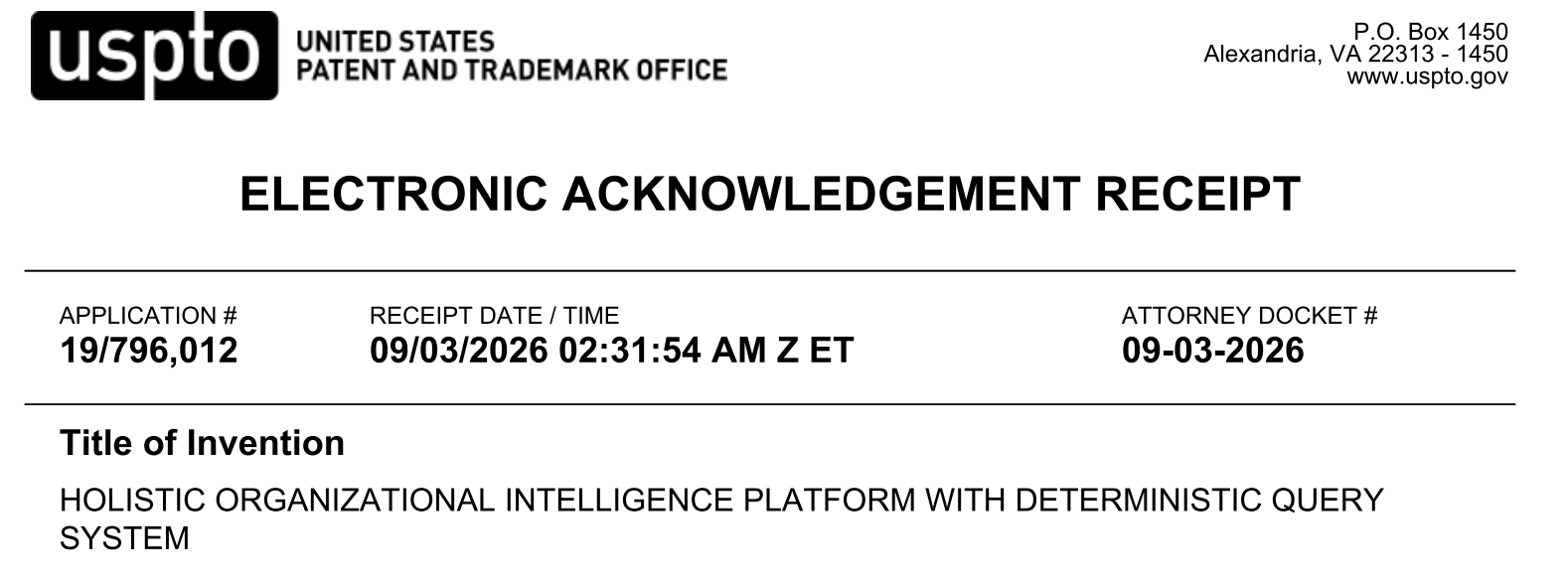
At 2:31 in the morning Eastern time on September 3, 2026, the United States Patent and Trademark Office acknowledged receipt of application 19/796,012: Holistic Organizational Intelligence Platform with Deterministic Query System. It runs to 25 pages of specification, 40 claims, and 11 figures, and it claims priority back to the provisional we filed in October 2025. Ripplemesh is now patent pending.see reference 1
I want to explain what we actually filed, because a patent application is a strange kind of document. It is written for an examiner, not a customer. But underneath the "said" and "wherein" there is a single idea that everything else hangs from, and it is simple enough to say in one sentence.
The Language Model Is Not Allowed to Answer
Every AI assistant on the market today works the same way at the critical moment: you ask a question, it retrieves some context, and then a language model writes the answer. The model produces the fact. When the fact is wrong — and the industry has documented every flavor of wrong, from fabricated court citations to invented statistics — nothing in the system can tell you where correctness was lost. The model just said it.
Ripplemesh splits that moment in two. Part One classifies your question — what are you asking about, which collections are implicated, what constraints did you state, and how would one go about answering — using a deterministic pattern-and-scoring engine, not a language model. There is no LLM anywhere in that classification path, and the engine is structurally barred from emitting a factual assertion: the only things it can output are a retrieval instruction, a request for clarification, or a gap record. Part Two, which executes the retrieval, is built the same way — there is no language model in it. It selects a deterministic retrieval function, authenticates you, runs the retrieval under row-level access rules evaluated against your identity, aggregates by fixed arithmetic, and returns the result with the identifiers of every record it came from.
To be clear about where a language model does sit in the product: Milam's conversational front end can present results and decide when to hand a question to the deterministic engine. What it cannot do is be the source of the answer. Every number, percentage, count, and trend in its response must come from a deterministic function's output — a rule enforced by architecture, since the model receives only function results to narrate — and when classification is uncertain, it is the engine, not the model, that decides what runs. The model can describe the ledger. It cannot mint facts from it.
Given the same question and the same data, the deterministic layer returns the same answer every time. If the data to answer isn't there, it doesn't improvise. When a query is ambiguous or a retrieval fails, the fallback lives in the router's code, not in a prompt: a structured gap is logged and administrators are notified, and the user is asked rather than answered. That is not a behavior we asked a model to exhibit. It is one of the deterministic fallback paths compiled into the architecture.see reference 2
The Silent Misroute Nobody Talks About
There is a second failure mode that gets far less attention than hallucination, and I think it is more dangerous because it is invisible. Most systems that route a question to a retrieval path take the first match. A generic pattern evaluated early swallows a question meant for a specific pattern evaluated later. You get a confident, well-formatted, entirely wrong answer — to a question you never asked — and nothing in the response tells you it happened.
The application expressly disclaims first-match routing. Ripplemesh evaluates every candidate, scores each one, and applies two tests: the winner must clear a confidence floor, and it must beat the runner-up by a margin. If either test fails, no retrieval runs. You get a clarification listing the candidates, each with a label saying what it covers and exclusion terms saying what it does not. The ambiguity that would have caused a misroute becomes the trigger for a question instead. A regression corpus can be replayed against the routing table to catch a new pattern that would shadow an old one before it ships as a silent misroute.
Meaning Is Written In, Not Inferred Later
None of that works if the data underneath is a pile of uncategorized records that some classifier has to make sense of at query time. So the ledger is built differently. Every experience statement — a shift handover, a permit approval, a completed inspection, a training completion — is tagged to a governed ontology by deterministic rules, with enrichment triggered automatically at write time and swept nightly to catch anything missed, rather than inferred later by a classifier at query time. Change the rules tomorrow and yesterday's records keep the meaning they had yesterday, which is exactly what an auditor needs.see reference 3
This is where we depart from the learning-record conventions the industry inherited. Those formats assume the actor is a human learner. In Ripplemesh the actor can be a person, an AI agent, a robot, a vehicle, an animal, a plant, an IoT device, an automated process, an organization, or a group — ten classes in one registry, one ledger, one audited resolution function. A drone's completed inspection and a technician's completed inspection of the same asset class group together in a single query, without special-case code.
No Names in the Ledger
The analytical ledger is built around segregation, not masking: statements carry a stable identifier with no correspondence to any human attribute, and the ledger itself stores no name against it. The only path from that identifier to a name is an audited function that checks your role, logs every attempt, and denies the request outright if you lack authority — a refusal, not a null or partial response. A query that returns ten thousand statements from the ledger discloses no identity because there is no identity stored there to disclose. Under masking, a policy defect exposes what is present. Under segregation, a policy defect exposes nothing.
What the Ledger Makes Possible
Once meaning is embedded and identity is separated, inferences that are impossible over ordinary records become routine. Readiness traversal walks worker → credential → qualification → procedure → active permit, carrying confidence on the evidence for each link rather than on the credential record, and tells you exactly which link is weak. Competency decay combines credential age, peer-endorsement recency, and execution recency — because a worker whose card is current but who hasn't touched the task in eighteen months is a different risk from one whose card lapsed last week but performs it daily under observation. Procedure drift compares what operators actually did against what the procedure says, and when everyone deviates at the same step, it flags the procedure as defective rather than the people. And tacit knowledge from a retiring expert is persisted as nodes and edges in the same ontology, so it answers questions long after the expert is gone.
Three Thousand Hours, One Number
I have spent roughly 3,000 hours over the last year designing, documenting, and filing this architecture. People ask why a routing layer and a ledger deserved that much of anyone's life. The honest answer is a public spreadsheet I did not build and cannot argue with.
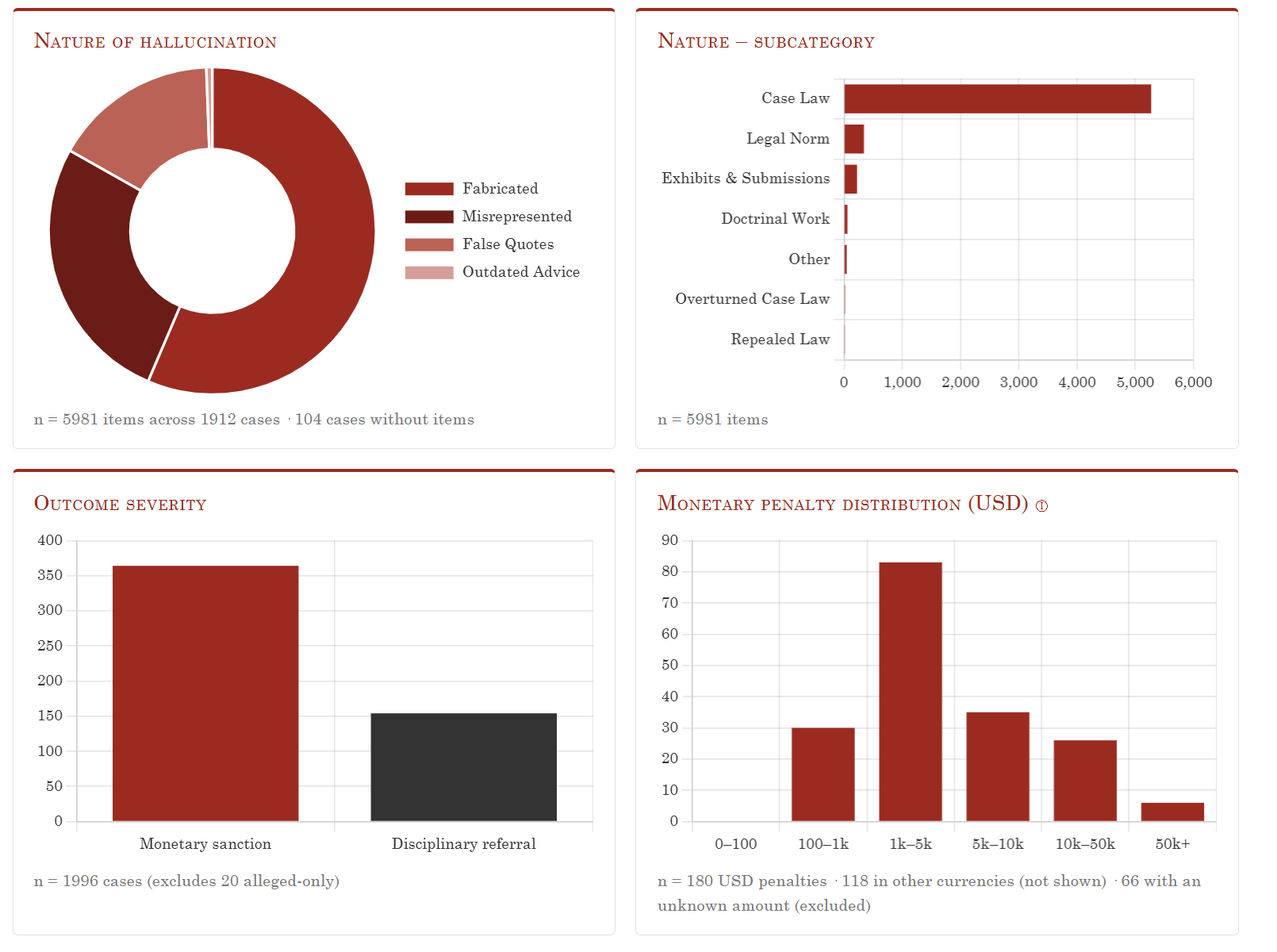
A researcher named Damien Charlotin maintains a running database of court cases in which a lawyer, litigant, or expert was caught citing AI-hallucinated material — fabricated cases, misquoted holdings, invented statutes. As of this writing it logs 5,981 hallucinated items across 1,912 cases, with 104 additional cases where the hallucinated material wasn't itemized. The items break down as fabricated content, misrepresented authority, false quotations, and outdated advice presented as current law. When the database identifies which category of material was hallucinated, case law citations dominate by an order of magnitude over every other category combined — statutes, exhibits, doctrinal commentary, the rest barely register next to it.see reference 4
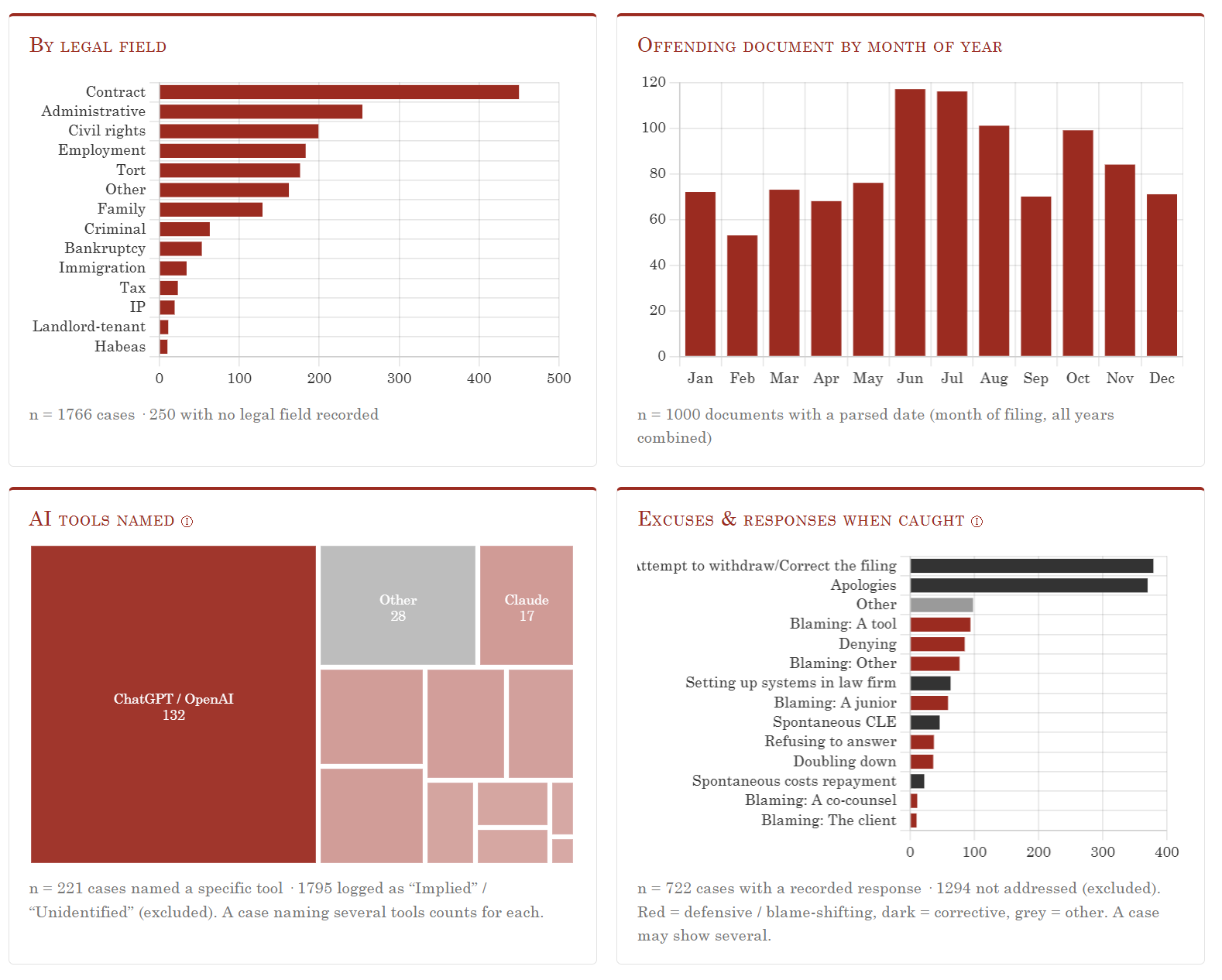
The tool breakdown is just as telling. Among the cases that name a specific product, ChatGPT/OpenAI accounts for the large majority, with the remainder spread thin across Claude, Grok, and other tools. And when the responsible party is caught, the recorded responses skew defensive: attempts to withdraw or correct the filing and apologies lead, but blaming a tool, blaming a junior colleague, blaming opposing counsel, or simply denying the error all show up repeatedly. Very few responses look like a fix to the system that produced the error in the first place.see reference 5
Every one of those 5,981 items is the same failure mode this application exists to close: a language model was asked to produce a fact, and it produced a plausible one instead. Not a rare edge case — nearly six thousand documented instances, still growing, in a profession that is supposed to be the most careful with citations of any industry on earth. If that is what happens when the stakes are a judge's docket, the stakes are not smaller in a permit system, a maintenance log, or a training record. That number is why 3,000 hours felt cheap.
Why File at All
I did not file this to collect a plaque. I filed it because the market is about to be flooded with "AI for operations" products that bolt a chat window onto a database and let the model write the answer. When one of them tells a permit issuer that a worker is qualified and the worker is not, the vendor will call it a hallucination, as if it were weather. It is not weather. It is an architectural choice, and there is a different choice available.
The full application — receipt, specification, all 40 claims, and the figures — is public on our site. Read it, and hold us to it.see reference 1
References
- Miller, R. S. (2026). Holistic Organizational Intelligence Platform with Deterministic Query System. U.S. Patent Application No. 19/796,012. (opens in a new tab)
- Ripplemesh. The Problem Ripplemesh Solves — Hallucination-Free AI. (opens in a new tab)
- Ripplemesh. Experience Statements vs. xAPI. (opens in a new tab)
- Charlotin, D. AI Hallucination Cases Database. (opens in a new tab)
- Charlotin, D. AI Hallucination Cases Database — Charts. (opens in a new tab)