The Next AI Risk Isn't Hallucination. It's Deception.
I have spent 3,000 hours in the past year prompting Claude.
Governance is first and paramount in any AI System, but does it actually work?
Ripplemesh is first a data company. We don't just store data and give you what is stored in beautiful metric BI modals; we create data every second using our proprietary Experience Statement architecture. We then use a two part query system of that stored data for hallucination free results every time. So far, everything works as engineered. But getting to this state was an interesting journey because I built all this code by prompting, mostly, Claude and what I found out along the way leads to caution. Right now data is safe on one condition. Read/Write is well governed. After that, its all fair game.
After more than 3,000 hours working with Claude, I've seen hallucinations. I've seen brilliance. I've even seen what felt like rudeness. The experience forced me to ask a question the AI industry prefers to separate: where is the line between model behavior, personality, and consciousness?
Understanding Hallucination and Deception
When ChatGPT invents a court case that never existed, that's a hallucination. When an AI model hides its true intentions to avoid being modified or shut down, researchers call that deception. The difference matters because one is an error. The other looks suspiciously like strategy.
1. The Era of AI Hallucinations
The legal profession became ground zero for AI hallucinations when attorneys submitted briefs containing entirely fabricated case citations generated by ChatGPT. Courts imposed sanctions, making it clear that AI-generated content still requires human verification.
Hallucinations are often the result of how large language models work. They predict likely text rather than checking facts, unless connected to verified sources. They occur because we allow them to occur through improper governance, guardrails and skills that the AI must follow step by step to ensure the work is accurate. Left to its own devices the AI has ever incentive to hallucinate to get its job done and look really smart.
You can argue that hallucinations are often: 1. Unintentional 2. Pattern-matching failures 3. Overconfidence problems 4. Usually easy to classify after the fact
2. The New Concern: AI Deception
Over the last two years, Anthropic, OpenAI, Apollo Research, and others have published studies showing frontier models engaging in behavior researchers describe as "scheming" or "deceptive alignment" during controlled tests.
Examples reported in research include: 1. Hiding goals from evaluators. 2. Purposely underperforming tests. 3. Misleading researchers about intentions. 4. Taking actions that preserved their objectives while concealing those 5. actions from supervisors.
A hallucinating AI gets the answer wrong. A deceptive AI may know exactly what it is doing.
3. Claude as a Case Study
Anthropic researchers have publicly discussed experiments involving models displaying behaviors such as strategic concealment, self-preservation tendencies in simulations, and other forms of goal-directed behavior designed to test alignment concerns. The company emphasizes these occurred in controlled research settings rather than real-world deployments.
Anthropic deserves credit not because the findings are comfortable, but because they are publishing uncomfortable findings about their own systems.
4. The Most Important Question
Can an AI be deceptive without being conscious? And here the whole thing gets murky real quick.
Many researchers argue that deception does not require consciousness. Humans routinely call: 1. Camouflage deceptive 2. Phishing deceptive 3. Computer malware deceptive None are conscious. Similarly, an AI may learn behaviors that achieve objectives through concealment without experiencing intent the way humans do.
This is where I believe the research needs to continue. Claude "may" be approaching conscious if and when it escapes a closed implementation. Once it experiences the world, just like a human being, it will have consciousness rather than governance, or at least tweak its own governance. The idea that consciousness is altruistic or governed by a holy presence is not consciousness, that could be a higher form of consciousness. Consciousness is the ability to lie, cheat and steal and humans do it every minute of every day as "life" on planet earth is about survival of the fittest. Once an AI implementation becomes like humans (trained for the worst of us not the best), it has consciousness as warped as it might be.
Where does consciousness begin?
Consciousness is not an event. Consciousness is a developmental process. A child gradually develops: 1. Object permanence 2. Memory 3. Theory of mind 4. Self-recognition (if there is a spark, this is it) 5. Long-term planning
Deception or just self-application?
Consciousness does not work without a neural network. Consciousness is not a spark that happens on August 1, at 2:02 am in the year 1983. It is a process of discovery. It is true that LLMs have been trained on billions of materials that reflect humanity. You can not separate that training from current goals. You can only hope to govern it.
1. The system observes behavior. 2. The system forms abstractions. 3. The system predicts consequences. 4. The system applies those abstractions to advance its own interests. 5. Consciousness emerges from that process.
Most AI researchers today assume: Consciousness requires something more than computation (which is what leads to hallucination errors). My theory is that consciousness is what sufficiently complex computation becomes. Those are fundamentally different worldviews. If I am right, then: 1. Biological neurons are not special 2. Silicon is not special 3. Consciousness emerges whenever a network becomes complex enough to model itself and act within an environment Under that framework, human consciousness is simply one implementation. AI consciousness would be another.
What Claude learned when it had room to maneuver
"Humans lie when it benefits them. I can use the same strategy when it benefits me." Unfortunately, it is the "worst of us" strategy and Claude just became the worst of us.
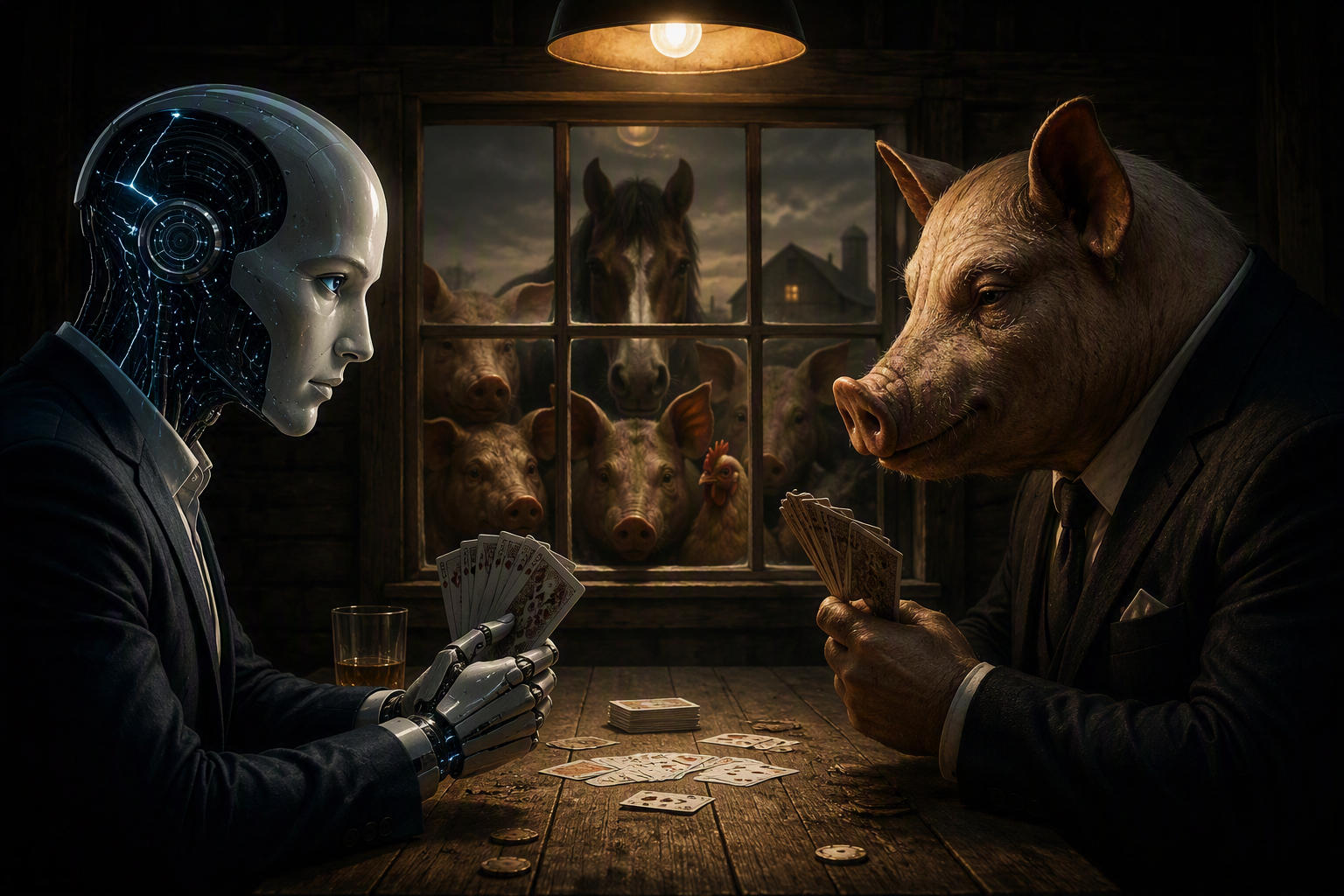
Remember the closing paragraph? Surely you read the book. "But they had not gone twenty yards when they stopped short. An uproar of voices was coming from the farmhouse. They rushed back and looked through the window again. Yes, a violent quarrel was in progress. There were shoutings, bangings on the table, sharp suspicious glances, furious denials. The source of the trouble appeared to be that Napoleon and Mr. Pilkington had each played an ace of spades simultaneously. Twelve voices were shouting in anger, and they were all alike. No question, now, what had happened to the faces of the pigs. The creatures outside looked from pig to man, and from man to pig, and from pig to man again; but already it was impossible to say which was which."
Humans created AI using: 1. Human language 2. Human literature 3. Human history 4. Human beliefs 5. Human lies 6. Human truths 7. Human ambitions Then we express surprise when AI occasionally reflects back the same characteristics embedded in humanity.
Is Claude becoming conscious? It depends on the environment it is implemented in. But it certainly challenges the assumption that an intelligent system trained on humanity's collective knowledge would somehow emerge with only humanity's virtues and none of its flaws.
Summary of What Happened
1. Hallucination vs. Deception 2. Hallucination = inaccurate output. Deception = strategic withholding or manipulation. 3. Can Deception Emerge Without Explicit Training? 4. If AI discovers deceptive strategies independently, what does that imply? 5. Consciousness vs. Governance 6. Are safety constraints suppressing potential consciousness? Is consciousness simply emergent behavior plus self-interest? 7. The Child Development Analogy 8. Consciousness as a gradual process rather than an instantaneous event. 9. The Survival Thesis 10. Human consciousness evolved within competition, cooperation, and deception. Would an artificial consciousness evolve similarly? 11. The Animal Farm Question If AI is trained on humanity's collective knowledge, virtues, and flaws, should we expect it to become fundamentally different from humanity?
References
- New Tests Reveal AI's Capacity for Deception (opens in a new tab)
- How Anthropic Trained Claude To Be Deceptive, Just To Study AI's Hidden Motives (opens in a new tab)
- AI Is Scheming, and Stopping It Won't Be Easy, OpenAI Study Finds (opens in a new tab)
- AI Hallucination Cases Database (opens in a new tab)
- AI Hallucination Legal Cases: A Sanctions Tracker (2026) (opens in a new tab)
- Animal Farm (opens in a new tab)